


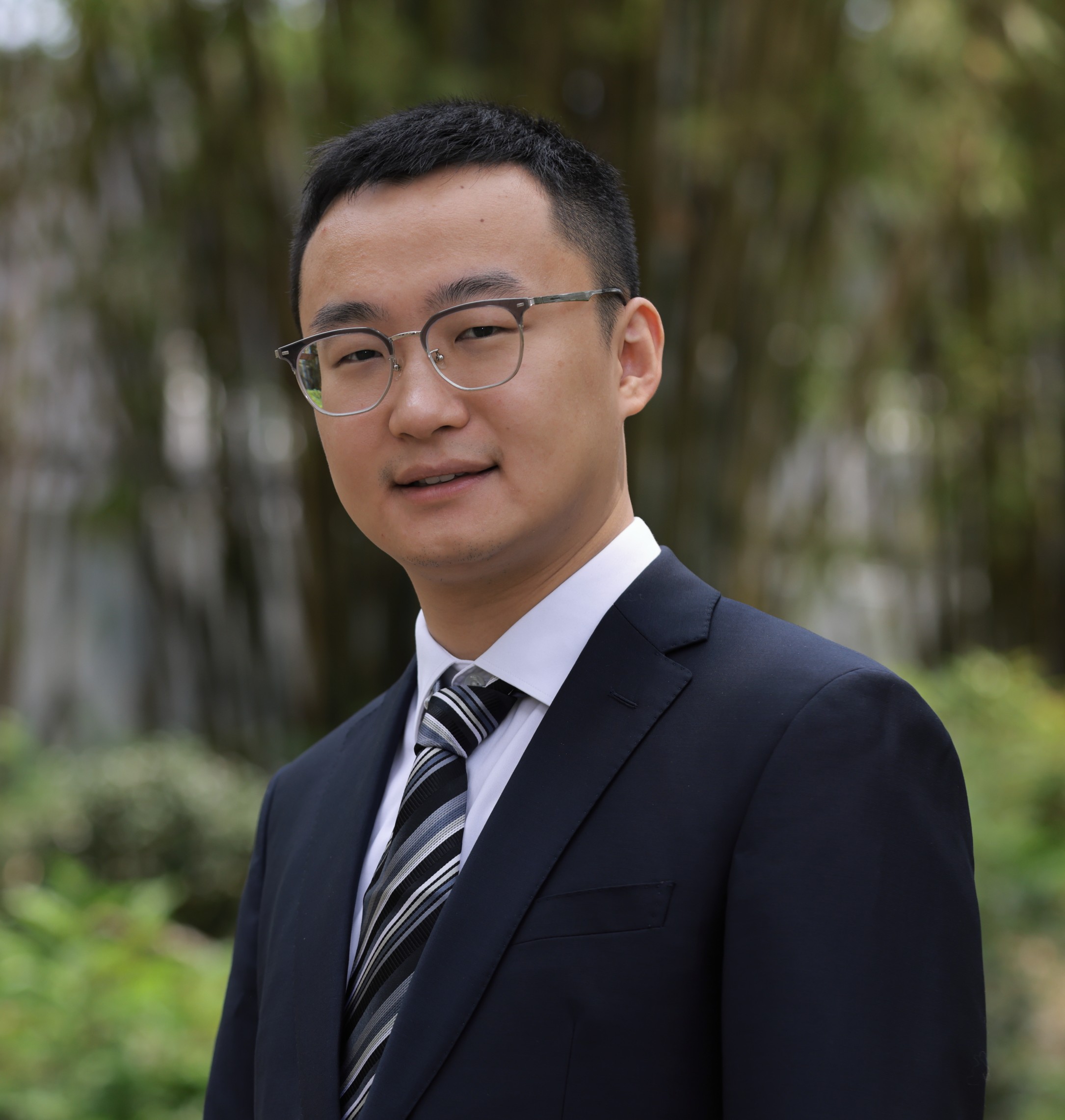
Dr. Leo Lizhou FAN
Vice-Chancellor Assistant Professor (Non-clinical)
Vice-Chancellor Assistant Professor (Non-clinical)
范犁洲博士
Ph.D. (Michigan, U.S.), BS (UCLA, U.S.)
Email: leofan[at]cuhk.edu.hk
Fax: (852) 2667-5464
Google Scholar: 95NLzC4AAAAJ
ORCID: 0000-0002-7962-9113
IRIS: https://research.cuhk.edu.hk/en/persons/lizhou-fan/
Research group website: https://psyai.group/
OTHER POSITIONS:
- Principle Investigator, CUHK Li Ka Shing Institute of Health Sciences
- Associate Researcher (by courtesy), CUHK Shenzhen Research Institute (SZRI)
AWARDS:
- Best Paper Award, International Conference on Mechatronics, Robotics, and Artificial Intelligence, 2025
- ACM SIGIR Student Travel Award, 2023
- Azure Credit Award, Microsoft Azure, 2023
- AWS Computing Award, NeuraIPS BigANN Competition, 2023
- Wiley Top Downloaded Article Award, John Wiley & Sons, Inc., 2021
RESEARCH INTERESTS:
- Medical AI
- Embodied AI
- Neuropsychiatric disorders
- Aging
- Sleep medicine
CURRENT PROJECTS:
- Sleep and Circadian Rhythm: Potential Window for Prevention of Mental Disorders in Adolescents
(Funded by Theme-based Research Scheme, Research Grants Council) 1/1/2026-31/12/2030; Capacity: co-PI - Leveraging smartphone-based ecological momentary assessment and explainable artificial intelligence to detect REM sleep behavior disorder and assess neurodegenerative risk in patients with major depressive disorder (Funded by Early Career Scheme, Research Grants Council) 1/1/2027-31/12/2028; Capacity: PI
- Responsible AI for Clinical Training and Patient-centered Informed Consent (Funded by the CUHK Vice-Chancellor Early Career Professorship Scheme) 1/8/2025-31/7/2028; Capacity: PI
- Generative AI and Virtual Reality–Enhanced Patient Simulation for Immersive Clinical Training (Funded by Teaching Development and Language Enhancement Grant, CUHK) 1/1/2026-31/12/2027; Capacity: PI
- SpectraHomeHelper: Transforming Pediatric Autism Spectrum Disorders Healthcare with AI-powered Home Monitoring and Patient Navigation (Funded by Knowledge Transfer Impact Project Fund, CUHK) 1/4/2026-31/3/2027; Capacity: PI
- Embodied AI-powered Socially Assistive and Home Care Robot for Sandwich Generation Households (Funded by Direct Grant for Research, CUHK) 30/6/2026-29/6/2027; Capacity: PI
- Virtual Patients for Neurological and Psychiatric Disorders Based on Multimodal Large Language Models (Funded by the Natural Science Foundation of Shandong) 1/10/2025-30/9/2028; Capacity: co-PI
SELECTED PUBLICATIONS:
- Fan, L.†, Li, X., Wang, X., Ni, J., He, Z., Yang, Y., Yu, H., Liang, Z., Tang, S., Gong, S., Li, N., Lin, X., Ma, X., Liu, Y., Zhang, J., Wang, J.†, Chan, J. W. Y., Chan, N. Y., Li, T. M. H., Huang, B., & Wing, Y. K.† (2026).
Multimodal AI for predicting comorbid REM sleep behavior disorder in major depressive disorder.
npj Digital Medicine. doi: 10.1038/s41746-026-03001-w - Yu, H., Zhou, J., Li, L., Chen, S., Gallifant, J., Shi, A., Li, X., Jin, M., Hua, W., Chen, G., Zhou, Y., Li, Z., Gupte, T., Chen, M.-L., Azizi, Z., Dou, Q., Yan, B., Zhang, Y., Assimes, T. L., Bitterman, D. S., Lu, L., Ma, X., & Fan, L. (2025)
Simulated patient systems powered by large language model-based AI agents offer potential for transforming medical education.
Communications Medicine. https://doi.org/10.1038/s43856-025-01283-x - Chen, S., Gao, M., Sasse, K., Hartvigsen, T., Anthony, B., Fan, L., Aerts, H. J. W. L., Gallifant, J., & Bitterman, D. S. (2025).
When Helpfulness Backfires: LLMs and the Risk of False Medical Information Due to Sycophantic Behavior.
npj Digital Medicine. doi: 10.1038/s41746-025-02008-z - Tian, H., Ma, J., Zhang, Y., Fan, L., Jiang, W., Ma, X., & Li, Y. (2025).
Skeleton-Based Continuous Scale Parkinsonian Gait Score Estimation Using Omni-Dimensional Self-Attention Convolution Networks.
IEEE Transactions on Neural Systems and Rehabilitation Engineering. doi: 10.1109/TNSRE.2025.3613967 - Wang, X.*, Fan, L.*, Li, H.*, Jiang, W., Bi, X., & Ma, X. (2025)
Skip-AttSeqNet: Leveraging Skip Connection and Attention-Driven Seq2seq Model to Enhance Eye Movement Event Detection in Parkinson’s Disease.
Biomedical Signal Processing and Control. doi: 10.1016/j.bspc.2024.106862 - Li, X.*, Fan, L.*†, Wu, H., Chen, K., Yu, X., Chao, C., Cai, Z., Niu, X., Cao, A. †, & Ma, X. † (2025)
Enhancing Autism Spectrum Disorder Early Detection with Parent-child Dyads Block-play Protocol and Attention-enhanced Hybrid Deep Learning Framework. Engineering Applications of Artificial Intelligence.
doi: 10.1016/j.engappai.2025.110430 - Sun, J., Lu, T., Shao, X., Han, Y., Xia, Y., Zheng, Y., Wang, Y., Li, X., Ravindran, A., Fan, L., Fang, Y., Lu, L., Zhang, X., Ravindran, N., Wang, Y., & Lu, L. (2025).
Practical AI application in psychiatry: Historical review and future directions.
Molecular Psychiatry. doi: 10.1038/s41380-025-03072-3 - Lv, C.*, Fan, L.*, Li, H.*, Ma, J., Jiang, W., & Ma, X. (2024)
Leveraging Multimodal Deep Learning Framework and a Comprehensive Audio-Visual Dataset to Advance Parkinson’s Early Detection.
Biomedical Signal Processing and Control.
doi: 10.1016/j.bspc.2024.106480 - Fan, L.†, Li, L., & Hemphill, L. (2024)
Toxicity on Social Media During the 2022 Mpox Public Health Emergency: Quantitative Study of Topical and Network Dynamics.
Journal of Medical Internet Research. doi: 10.2196/52997 - Fan, L.†, Li, L., Ma, Z., Lee, S., Yu, H., & Hemphill, L. (2024).
A bibliometric review of large language models research from 2017 to 2023.
ACM Transactions on Intelligent Systems and Technology, 15(5), Article 91, 1–25. doi: 10.1145/3664930